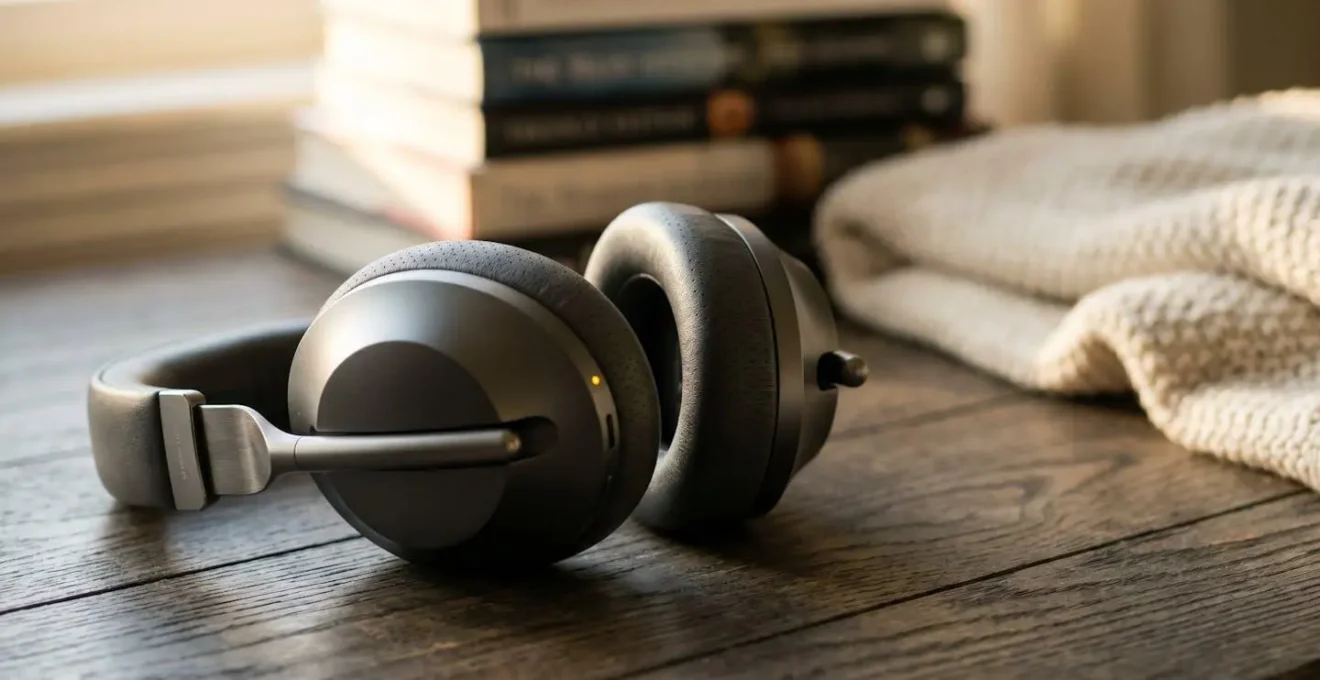
Spatial audio isn’t magic; it’s a set of psychoacoustic tools you can master to create a private cinema, even with thin walls.
- Personalizing your Head-Related Transfer Function (HRTF) via ear scanning is non-negotiable for true immersion.
- Active Noise Cancellation (ANC) targets low-frequency drones, while passive isolation from foam tips blocks high-frequency chatter.
Recommendation: Combine personalized spatial audio with a hybrid ANC/passive isolation strategy for the ultimate private listening experience.
Living in a shared space like a university hall presents a classic acoustic dilemma: you crave the thundering, immersive sound of a cinema for your late-night movie sessions, but your flatmates—and the paper-thin walls—demand silence. The common advice is often to “just buy noise-cancelling headphones,” but that barely scratches the surface of the audio engineering challenge you’re facing. True immersion isn’t just about blocking out the world; it’s about convincingly building a new one inside your head.
Many people turn on their device’s “Spatial Audio” feature and expect a magical transformation, only to find the effect underwhelming or even distracting. They treat it like a simple on/off switch, unaware of the complex psychoacoustic principles at play. The reality is that achieving a private, believable soundscape is an act of personal acoustic engineering. It requires moving beyond the marketing hype and understanding the delicate interplay between your own unique anatomy, the hardware you’re using, and the source material you’re playing.
But what if the key wasn’t just in the technology, but in how you configure and manipulate it? What if, instead of just consuming a generic 3D effect, you could tailor it so precisely that sound objects feel anchored in your room, independent of your head movements? This is where an engineer’s mindset comes in. It’s about understanding the “why” behind the “what”—why some sounds are perfectly cancelled while others leak through, why a personalized ear scan is more than a gimmick, and critically, when to turn spatial processing off entirely to preserve the artist’s original intent.
This guide will deconstruct the science of spatial audio from an engineering perspective. We’ll explore the technology that anchors sound in space, the critical importance of your ear’s unique geometry, the trade-offs that can make or break a music mix, and the practical strategies for blocking out the real world so you can get lost in a cinematic one, all without a single noise complaint.
To help you navigate this complex topic, this article breaks down the essential components for creating your personal sound bubble. The following sections will guide you through the technical principles, practical applications, and critical decisions needed to master immersive audio in a shared environment.
Summary: Immersive Spatial Audio Tech: How to Enjoy Cinema Sound Without Disturbing Flatmates?
- Why does the sound stay in place when you turn your head?
- How to scan your ear shape to personalize the spatial audio effect?
- Stereo or Spatial: when does the 3D effect actually ruin the music mix?
- The streaming service restriction that blocks spatial audio on Android
- When to use phone speakers vs headphones for the best spatial experience?
- Active vs Passive Cancellation: which actually blocks out a jackhammer?
- How to use the game dashboard to cap frame rates and save 20% battery?
- Convincing 360-Degree Effect: How to Hear Enemy Footsteps Before You See Them?
Why does the sound stay in place when you turn your head?
The “magic” of spatial audio, where a sound source remains fixed in space as you turn your head, is a feat of high-speed computation and sensor fusion. It’s not the audio itself that’s special; it’s the constant, real-time recalculation of how that audio should reach your ears. Your headphones contain a combination of gyroscopes and accelerometers, the same technology that lets your phone know when you’ve rotated it. These sensors continuously report the precise orientation of your head to your device’s audio processor.
When you’re facing a virtual sound source (like an actor on screen) and you turn your head to the left, the sensors detect this motion. The audio processor then instantly adjusts the sound mix. The audio that was previously being sent equally to both ears is now altered: it becomes slightly louder and arrives fractionally sooner in your right ear, while becoming quieter and arriving later in your left. This mimics the exact psychoacoustic cues your brain uses to locate sounds in the real world. For this illusion to be convincing, the entire process—from motion detection to audio adjustment—must happen incredibly fast. According to Android’s official spatial audio implementation guidelines, the round-trip latency must be less than 150 milliseconds to remain believable.
If this delicate calibration fails, the immersion is instantly broken. The sound may “drift” over time, or it might feel unnaturally stuck to your head movements. This can be caused by a variety of factors, from low battery affecting sensor performance to software glitches. Maintaining this stable, virtual soundstage is the foundation of a truly immersive experience, separating high-end implementations from more basic “virtual surround” effects.
Your action plan: Troubleshooting head-tracking immersion issues
- Check battery life: Head-tracked audio consumes significantly more power. Verify headphone and device battery levels, as low power can degrade sensor performance.
- Verify sensor compatibility: Ensure your headphones contain both gyroscopes and accelerometers, as head tracking requires both working in tandem.
- Test in optimal positions: Avoid lying down flat or making extremely rapid head movements, as these conditions can cause tracking algorithms to lose calibration and break the illusion.
- Reset head-tracking calibration: If the sound feels “drifted” or off-center, remove and re-wear the headphones, or simply toggle the head-tracking feature off and on in your device’s settings to force a recalibration.
- Update firmware: Always check for and install the latest firmware updates for both your headphones and your streaming device, as software glitches in the processing algorithms are a common cause of tracking errors.
How to scan your ear shape to personalize the spatial audio effect?
The most sophisticated spatial audio relies on a concept called the Head-Related Transfer Function (HRTF). Put simply, an HRTF is a unique acoustic fingerprint that describes how your brain perceives sound direction based on the physical shape of your head, torso, and especially your outer ears (the pinnae). The precise way sound waves bounce off the curves and folds of your ears before entering the ear canal provides your brain with vital directional cues. A generic “one-size-fits-all” spatial audio algorithm uses an average HRTF, which can feel unnatural or place sounds incorrectly.
To create a truly convincing and personalized 3D soundscape, the system needs to know your specific HRTF. This is where ear scanning comes in. Modern implementations use your phone’s camera to capture the unique geometry of your ears.
This process creates a 3D model, allowing algorithms to calculate a personalized HRTF. As the Pawpaw Technology Research Team notes in their Head-Related Transfer Function Technical Analysis:
Using a generic HRTF can result in localization errors and auditory fatigue, negatively impacting the user experience.
– Pawpaw Technology Research Team, Head-Related Transfer Function Technical Analysis
Case Study: Apple’s TrueDepth Camera HRTF Personalization
Apple’s iOS 16 introduced a prime example of this technology. It leverages the TrueDepth camera system found on newer iPhones to capture a 3D model of a user’s head and ears. The process, performed at home, allows the system’s algorithms to analyze the data and calculate a unique HRTF. This creates a personalized audio profile that significantly optimizes the spatial audio experience in devices like AirPods, tailoring the directional cues to the individual’s anatomy for improved accuracy and realism.
This personalization is the single most important step you can take to move from a gimmicky surround effect to a truly believable and immersive private cinema. It ensures that when a sound is meant to be behind you, your brain actually perceives it as being behind you, because the audio has been processed to mimic how that sound would naturally interact with your own ears.
Stereo or Spatial: when does the 3D effect actually ruin the music mix?
While spatial audio can be a game-changer for movies and games designed for surround sound, its application to music is a highly contentious topic among audio engineers and producers. The issue lies in the source material. A film is mixed in a multi-channel environment (5.1, 7.1, Dolby Atmos) from the ground up, with sound objects intentionally placed around the listener. Most music, however, is painstakingly mixed and mastered for a two-channel stereo field. Applying a spatial algorithm to a stereo track is an act of “upmixing”—an educated guess at how to spread a two-channel recording into a 3D space.
This process can often do more harm than good, fundamentally altering the artist’s intent. Critical elements like the lead vocal, kick drum, and bass line are typically placed dead-center in a stereo mix for focus and impact. Upmixing can diffuse these core elements, pushing the vocal back and smearing its presence. As music producer Russ Hughes noted in his analysis of early Apple Music Spatial Audio quality:
Spatial Audio smears the mix and removes focus, especially from things like the main vocal. The tradeoff is not just width versus narrowness, but focus versus diffusion.
– Russ Hughes, Analysis of Apple Music Spatial Audio quality issues
For a student listening in their dorm, this means making a conscious choice. Are you seeking an ambient, spacious background vibe, or are you trying to connect with the raw emotion and power of the original recording? For critical, focused listening, especially with certain genres, the artist’s original stereo mix is almost always superior. Turning spatial processing off isn’t a failure; it’s an informed engineering decision to prioritize mix integrity over artificial space.
- Spatial audio EXCELS with: Classical orchestral recordings (recreating authentic acoustic environments), live concert albums (preserving venue ambiance), ambient electronic music, and film scores originally mixed for surround.
- Spatial audio FAILS with: Intimate vocal-driven tracks (smears vocal presence), mono-era recordings from the 1960s or earlier (artificially spatializes a single-channel source), lo-fi and bedroom pop (destroys intentional rawness), and heavily compressed hip-hop/EDM (diffuses the center-channel punch).
- The Test Approach: When listening to a familiar song, toggle spatial audio on and off. If the vocals feel distant or instruments seem disconnected, switch back to stereo to honor the original mix.
The streaming service restriction that blocks spatial audio on Android
While Apple has created a tightly integrated and relatively seamless spatial audio experience within its “walled garden” ecosystem, the Android world is far more complex and fragmented. For a student with an Android phone, getting spatial audio to work isn’t always as simple as pairing a compatible set of headphones. The functionality is often locked behind a series of hardware, software, and even manufacturer-specific “bubbles.”
Unlike Apple’s unified approach, where the operating system, device, and headphones are all designed by one company, Android’s open nature means each manufacturer—Google, Samsung, Sony, etc.—is responsible for its own implementation. As a study from Gaudiolab on Android’s fragmented ecosystem points out, this results in incompatible systems. Samsung’s “360 Audio” might only work with specific Samsung Galaxy phones and Galaxy Buds, while Google’s native spatial audio, introduced with a Pixel update, was initially limited to Pixel phones paired with Pixel Buds Pro. There is no single, standardized method that works across all Android devices.
This fragmentation means you, the user, must act as the system integrator. Before investing in expensive headphones, you need to verify that your specific phone model, your headphone model, AND your streaming app of choice (Netflix, Disney+, etc.) all support the same spatial audio protocol. Furthermore, the technical requirements are stringent; the system must be able to switch codecs on the fly. As per Android’s own guidelines, the system uses low-latency codecs like Opus for head-tracked spatial audio but must switch to low-power codecs like AAC for standard audio to conserve battery, a process that requires tight coupling between the phone and earbuds.
For a student on a budget, this is a critical consideration. It’s easy to assume any “spatial audio” headphones will work with any Android phone, but the reality is a patchwork of proprietary technologies. Your best bet is to research compatibility for your specific device pairing or opt for headphones that offer their own self-contained spatial audio processing via a dedicated app, bypassing the native Android system limitations altogether.
When to use phone speakers vs headphones for the best spatial experience?
The promise of spatial audio is now available through two very different delivery methods: the intimate, isolated world of headphones, and the open, virtualized sound of your phone’s built-in speakers. For a student in a shared living situation, the choice between them is a critical trade-off between immersion, privacy, and situational awareness. While headphones seem like the obvious choice for not disturbing flatmates, there are specific scenarios where using your phone’s speakers can be a surprisingly viable, albeit compromised, option.
Headphones with personalized HRTF and dynamic head-tracking will always provide the most convincing and immersive 360-degree experience. The sound is delivered directly to your ears without interference from room acoustics, and the seal of the earcups provides a high degree of acoustic privacy. However, this total isolation can be a downside when you need to maintain some connection to your environment, like when you’re expecting a delivery or need to hear if your flatmate is calling you.
Conversely, many modern phones (like iPhones and high-end gaming phones) feature stereo speakers with sophisticated virtualization algorithms that can create a surprisingly wide and spatial soundstage. While this effect is limited by the small size and fixed position of the speakers and is highly susceptible to room acoustics, it offers one major benefit: you remain aware of your surroundings. The biggest drawback, of course, is the complete lack of privacy. This method is only suitable for casual viewing when you’re alone or watching with a partner in close proximity.
The following table, based on analysis from audio experts, breaks down the key differences to help you make the right choice for your situation.
| Criterion | Wireless Headphones (Spatial Audio) | Phone Speakers (Spatial Virtualization) |
|---|---|---|
| Immersion Level | High – Head tracking creates convincing 360° soundscape anchored to environment | Moderate – Limited by speaker placement and room acoustics, no head tracking |
| Flatmate Disturbance Risk | Minimal – Sound contained within ear cups, though some leakage at high volumes (75%+) | High – Sound audible throughout shared spaces, defeats privacy purpose |
| Situational Awareness | Low – Active isolation blocks ambient sounds, not suitable when awareness needed | High – Maintains connection to environment, suitable for passive listening while cooking or expecting deliveries |
| Sound Quality | Superior – Personalized HRTF, dynamic head tracking, minimal environmental interference | Good – Some phones (iPhone, gaming phones) support spatial virtualization but limited by speaker size and positioning |
| Use Case | Active immersive sessions: movies, gaming, focused music listening | Shared-but-separate viewing with partner, casual content, situations requiring environmental awareness |
| Battery Impact | High – Head-tracked spatial audio consumes significantly more power | Moderate – Speaker playback consumes less than Bluetooth streaming |
Active vs Passive Cancellation: which actually blocks out a jackhammer?
To create your private cinema, you must first build the walls. In the world of headphones, this is achieved through two distinct methods: Passive Noise Isolation and Active Noise Cancellation (ANC). Confusing the two is a common mistake, yet understanding their different physical principles is key to effectively silencing your environment. They are not interchangeable; they are complementary tools that target different types of noise.
Passive Noise Isolation is purely mechanical. It’s a physical barrier that blocks sound waves from reaching your ear, just like covering your ears with your hands. This is achieved by the headphone’s materials and design—a good seal from over-ear cups or, more effectively, the dense, conforming material of high-quality foam ear tips. Passive isolation is most effective at blocking out high-frequency sounds (above 1-2 kHz). This includes noises like the clatter of dishes, the clicking of a keyboard, or the sharp, sibilant parts of human speech. It’s your first line of defense against sudden, sharp noises.
Active Noise Cancellation (ANC), by contrast, is an electronic system. It uses tiny microphones to listen to ambient sound and then generates an inverse sound wave—a perfect “anti-noise”—that is played back through the headphone speakers. When the original noise and the anti-noise wave meet at your eardrum, they cancel each other out. Due to the physics of wavelength and processing speed, ANC is overwhelmingly effective at neutralizing low-frequency, constant sounds (below 1 kHz). Think of the persistent drone of an airplane engine, the hum of a refrigerator or AC unit, or the bass-heavy rumble of traffic or a distant party. It cannot, however, react fast enough to cancel sudden, high-frequency sounds like a jackhammer’s initial impact—that’s a job for passive isolation.
For a student in a dorm, the ultimate solution is a hybrid approach. You need excellent passive isolation from well-fitting ear tips to block out your flatmate’s high-pitched chatter and keyboard-mashing, combined with effective ANC to eliminate the low-frequency hum from the shared mini-fridge and the bass bleeding from the room next door.
Your action plan: Selecting noise cancellation for flatmate frequency ranges
- For low-frequency household noises (TV dialogue, AC hum, refrigerator buzz): Prioritize headphones with strong Active Noise Cancellation (ANC), as it excels at cancelling these constant drones below 1kHz.
- For high-frequency noises (keyboard clicks, high-pitched chatter, dishes clattering): Focus on passive isolation. A great seal from premium memory foam ear tips is often more effective than any active technology.
- For mid-frequency conversation: A combination is best. ANC targets the bass tones in voices, while a good passive seal blocks the higher harmonics and consonants, creating effective speech isolation.
- To minimize ‘cabin pressure’: If you’re sensitive to the pressure sensation from strong ANC, look for headphones with ‘adaptive’ or ‘transparency’ modes, or models known for softer ANC algorithms.
- Budget-conscious solution: Don’t underestimate the power of a good seal. Excellent passive isolation from premium foam ear tips on affordable earbuds can achieve 80% of the effectiveness of expensive ANC for typical apartment noises.
How to use the game dashboard to cap frame rates and save 20% battery?
Your immersive cinema session is underway, but halfway through the final act, the dreaded “low battery” notification appears, shattering the illusion. For a student, battery life is a precious resource. While spatial audio and noise cancellation are heavy power consumers, one of the biggest drains is often the display. This is where you can borrow a clever power-saving strategy from the world of mobile gaming: manually controlling your device’s performance.
Many Android phones, especially those from Samsung or dedicated gaming brands, include a “Game Dashboard” or “Game Launcher” utility. While designed for gaming, its features can be applied to any app, including media players like Netflix or Plex. By adding these apps to the Game Launcher, you unlock a suite of performance-tuning tools. The most impactful of these is the ability to cap the screen’s refresh rate. Modern phone screens run at 90Hz, 120Hz, or even higher for smooth scrolling, but cinematic content is almost always filmed and delivered at 24, 25, or 30 frames per second (fps). Running your display at 120Hz to watch a 24fps movie is an enormous waste of energy.
By using the game dashboard or manually going into your phone’s display settings to force a 60Hz refresh rate, you can reduce GPU load and extend battery life by a significant margin—often 15-20% or more over a two-hour movie. This same utility can also be used to block notifications and disable background data sync for other apps, preventing interruptions and further conserving resources. It’s about treating your movie-watching session with the same focus as a competitive gaming match, optimizing your device for a single, sustained, immersive task. This also relates to how audio codecs are managed; according to Android’s official audio HAL implementation guidelines, the system automatically switches from high-performance codecs for spatial audio to low-power ones for standard content to optimize battery, a principle you can apply to your entire device.
Your action plan: Applying gaming battery strategies to movie sessions
- Enable Game Mode for media apps: On devices like Samsung’s, add Netflix, Plex, or YouTube to the Game Launcher to access Game Booster features during playback.
- Cap refresh rate to 60Hz: Before starting your movie, navigate to Display settings and force a 60Hz refresh rate. This alone can save 15-20% battery compared to a 120Hz display.
- Disable background sync: Use Game Mode or your phone’s Focus Mode to prevent background apps from consuming resources and interrupting your ‘immersive cinema session.’
- Lower screen brightness strategically: Since you’re likely watching in a darker environment, reduce brightness to 40-50%. The display is often the largest battery consumer.
- Monitor trade-offs: Test if capping the frame rate lower (e.g., to 30fps) creates audio-sync issues with fast action scenes. For most cinematic content, 60Hz is a safe and efficient bet.
Key takeaways
- True spatial immersion requires a personalized HRTF, making an ear scan a crucial first step, not a gimmick.
- The best noise isolation for a shared space is a hybrid approach: Active Noise Cancellation (ANC) for low-frequency drones and passive isolation for high-frequency chatter.
- Spatial audio processing is not always desirable; for music with a strong central vocal or a classic stereo mix, disabling it often preserves the artist’s original intent and provides a better listening experience.
Convincing 360-Degree Effect: How to Hear Enemy Footsteps Before You See Them?
You’ve personalized your HRTF, engineered your noise isolation, and optimized your battery life. You have all the technical components for a perfect private cinema. The final piece of the puzzle, however, isn’t in the technology—it’s in your brain. Achieving a truly convincing 360-degree effect, whether for watching a tense thriller or hearing enemy footsteps in a game, involves actively training your brain to trust and interpret the new set of psychoacoustic cues your headphones are providing.
For our entire lives, our brains have correlated directional sound with a full-body sensory experience. When you hear a sound from behind, your ears, head, and even the pressure on your shoulders all contribute to that perception. Headphone-based spatial audio strips away most of those physical cues, relying solely on manipulating the sound that enters your ear canals. At first, your brain can be skeptical of this purely auditory illusion. The key to bridging this gap is practice and calibration—what audio engineers and competitive gamers call “ear training.”
This involves intentionally focusing on directional sounds in a controlled environment. By listening to content with predictable and pronounced spatial cues—like binaural audio demonstrations, specific movie scenes, or the audio design of first-person shooter games—you teach your brain to recognize and trust the digital HRTF. You learn to discern height channels, differentiate between sounds that are merely “to the side” versus “behind and to the side,” and build a reliable mental map of the virtual space. This is the skill that separates a passive listener from an active participant in the soundscape, allowing you to achieve a level of immersion where you react to a sound cue before you even consciously process it.
Your action plan: Ear training exercises for better spatial immersion
- Test with controlled binaural recordings: Start with classic demos like the ‘virtual barber shop’ on YouTube to calibrate your brain’s ability to locate sounds in 3D space with headphones.
- Practice with gaming audio: Play first-person shooters (e.g., Call of Duty, Valorant) with spatial audio enabled, focusing on identifying footstep direction before visual confirmation. Games provide instant feedback on your spatial accuracy.
- Movie scene drills: Watch key scenes with complex sound design, like the opening of ‘Gravity’ (debris field), the basement scene in ‘A Quiet Place’ (creature movement), or ‘Dunkirk’ aerial sequences, to train your recognition of height and rear-channel cues.
- Intentionally disable visuals: Listen to action movie scenes with your eyes closed or the screen dimmed to force your brain to rely solely on directional audio, building the same ‘sound-first’ awareness that gaming cultivates.
- Recognize when to toggle off: For dialogue-heavy dramas or comedies, test switching to stereo. If the dialogue feels more present and emotionally connected, prioritize clarity over a spatial gimmick.
Armed with this engineering mindset, you can now move beyond being a passive consumer of technology. You have the knowledge to deconstruct the hype, diagnose the problems, and systematically build a personal audio environment that is both deeply immersive and respectfully private. Your dorm room can become your cinema, not through magic, but through deliberate, informed choices.