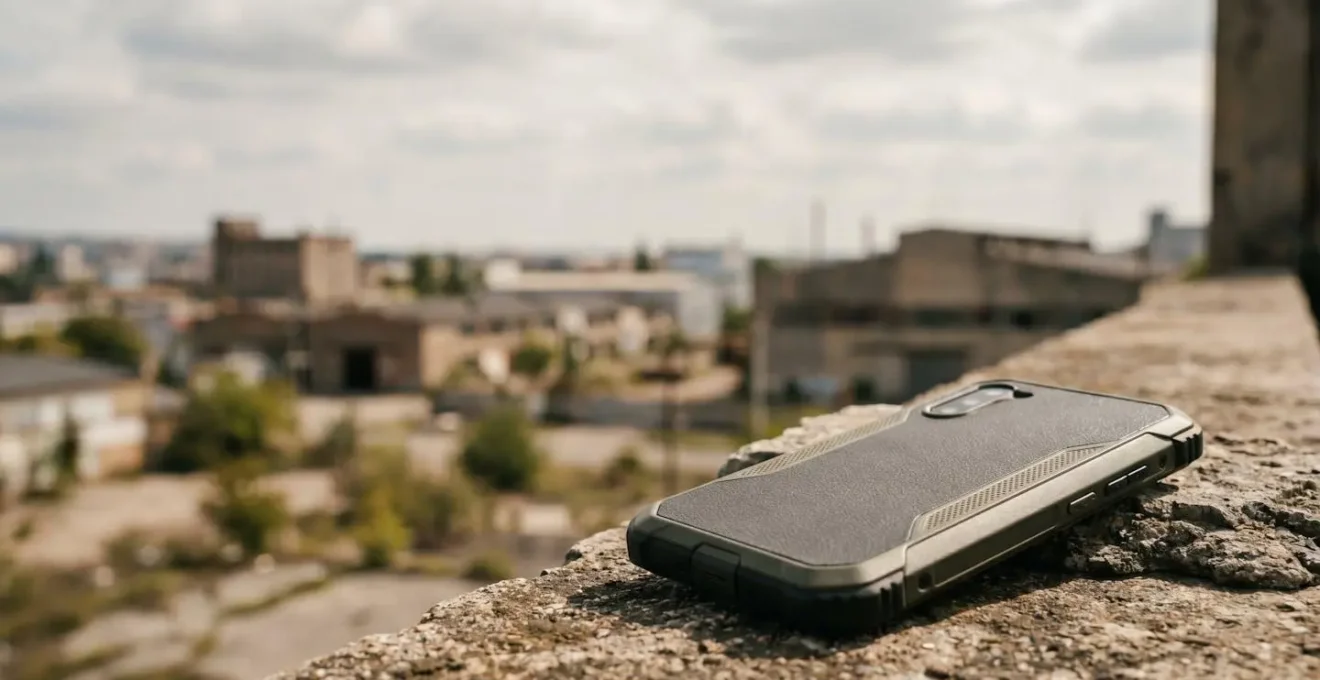
Despite the marketing, “Military-Grade” is not a guarantee of invincibility; it’s a menu of lab tests, and its value depends entirely on which specific tests a phone passed.
- The standard tests for specific threats like vibration, thermal shock, and controlled drops, which have surprising relevance to daily life.
- Real-world conditions (like concrete surfaces or car vibrations) often exceed the controlled lab environment, and warranties almost never cover accidental damage.
Recommendation: Look beyond the MIL-STD-810H label and investigate the specific tests passed, understand material science, and accept that “rugged” reduces risk but doesn’t eliminate it.
You’ve seen the label on the box or in the product description: “MIL-STD-810H Certified.” It conjures images of a device that can survive a warzone, shrugging off drops, dust, and downpours. It feels like a promise of ultimate durability, a key reason to choose one phone over another. But as a technician who spends their days verifying these claims, I can tell you the reality is far more nuanced. That “military-grade” sticker is often used as a blunt marketing tool, masking the complex truth of what it actually represents.
Most consumers equate the certification with simple drop-proofing, comparing it vaguely to an IP rating for water resistance. This misses the point entirely. The MIL-STD-810H standard isn’t a single pass/fail grade for toughness. It’s a comprehensive document detailing dozens of environmental stress tests, from gunfire shock to salt fog. A manufacturer can pick and choose which tests to perform, meaning two “MIL-STD-810H certified” phones can have wildly different capabilities. The true value isn’t in the label itself, but in understanding the engineering trade-offs and how specific, often overlooked, tests translate to the real-world hazards your phone faces every day.
But what if the greatest threats to your phone’s longevity aren’t the dramatic six-foot drops, but the subtle, cumulative stresses of your daily routine? The key to making an informed decision is to stop thinking of MIL-STD-810H as a shield and start seeing it as a technical specification sheet. This guide will dissect what the most relevant tests actually involve, why the fine print on your warranty matters more than the sticker on the box, and how the science of materials—not just certifications—determines whether your phone survives its encounter with a concrete floor.
To truly understand what this military standard means for your civilian life, we’ll break down the specific tests and real-world scenarios that matter most. This analysis will equip you to see past the marketing and evaluate a phone’s durability with a critical, informed eye.
Summary: Decoding Military-Grade Durability for Everyday Life
- Why the vibration test matters more than the drop test for commuters?
- How “military grade” helps when using your phone in a steamy bathroom?
- IP68 or MIL-STD-810H: which one saves you from a toilet drop?
- The shock damage exclusion that applies even to “rugged” phones
- Why “drop tested” means nothing without a specific height certification?
- Metal or Polymer frames: which absorbs shock better on a concrete floor?
- Polymer vs Glass Shells: Which Material Survives a 2-Metre Drop onto Concrete?
- How to treat a rugged phone so it actually lasts 5 years?
Why the vibration test matters more than the drop test for commuters?
While a catastrophic drop gets all the attention, the most insidious damage for a daily commuter often comes from a source you willingly expose your phone to for hours: your car or motorcycle mount. The constant, high-frequency vibrations from an engine and road surfaces are a form of cumulative stress that a simple drop test doesn’t measure. This is where MIL-STD-810H, Method 514.8 (Vibration) becomes critically relevant. This test procedure exposes a device to a range of vibration profiles to see if internal components fail, screws loosen, or circuit boards crack over time.
The most vulnerable component is your phone’s camera system, specifically the Optical Image Stabilization (OIS). OIS works by physically moving the lens or sensor with tiny motors and electromagnets to counteract your hand’s shaking. These are delicate, precision-engineered mechanisms. As Apple Inc. officially warns, long-term direct exposure to high-amplitude vibrations can degrade and permanently damage these systems. In fact, technical analysis from repair specialists links nearly 65% of camera shaking issues to high-frequency vibration damage from vehicle mounts. A phone that has passed the vibration test has proven its internal construction can better withstand this specific, common, and destructive environmental stress.
The image above reveals the microscopic complexity of an OIS module—the tiny coils and suspension wires that are susceptible to fatigue from constant vibration. A single drop is a test of impact resistance; a thousand miles in a dashboard cradle is a test of endurance. For a commuter, a phone certified against Method 514.8 offers more practical protection for its most complex component than one that only boasts about surviving a fall.
How “military grade” helps when using your phone in a steamy bathroom?
You bring your phone into the bathroom to listen to music or a podcast while you shower. The room fills with steam. You might think the primary danger is water getting in, a risk supposedly covered by an IP rating. However, a more subtle and potentially more damaging threat is thermal shock. This occurs when a device moves rapidly between temperature and humidity extremes—for instance, from a cool, air-conditioned room to a hot, steamy bathroom. This is precisely the scenario addressed by MIL-STD-810H, Method 503.7 (Thermal Shock).
This test doesn’t just dip a phone in water; it subjects it to rapid temperature swings. According to the specifications, this can involve temperature transitions between -40°F and 160°F (-40°C to 71°C) in minutes. The purpose is to identify failures caused by differential expansion and contraction of materials. When your cool phone enters a hot, humid environment, the air inside the “sealed” chassis can’t hold as much moisture, causing condensation to form directly on internal electronics. This internal moisture can cause short circuits and corrosion that an IP rating, which only tests for external liquid ingress, offers no protection against.
Case Study: Thermal Shock Testing Protocol
The MIL-STD-810H Method 503.7 protocol is designed to evaluate device resilience to changes exceeding 10°C per minute. The goal is to find weaknesses like the shattering of camera lenses, stress fractures from materials expanding at different rates, and seal failure. As testing firm Trenton Systems notes in their analysis, the test specifically addresses the risk of moving a device from a cold, air-conditioned space into a hot, humid one. This is exactly the bathroom scenario, where the rapid formation of internal condensation is a greater risk than a splash of external water. A phone that passes this test has proven its seals and material tolerances can withstand the pressure changes and prevent this invisible, internal threat.
So, while your IP rating might protect you from dropping the phone in the sink, it’s the MIL-STD-810H thermal shock certification that provides a better assurance against the damage caused by just having it in the room while you shower. It’s a classic example of an environmental mismatch, where the real-world threat isn’t what consumers assume it is.
IP68 or MIL-STD-810H: which one saves you from a toilet drop?
This is a trick question. The answer is likely “neither,” at least not in the way you’d hope. First, let’s clarify what each standard tests. An IP68 rating specifically measures resistance to solid (dust) and liquid (water) ingress under controlled laboratory conditions. The “8” signifies the device can survive submersion, but the depth and duration are defined by the manufacturer, not the standard. This leads to significant variance; for instance, an iPhone 13 is rated for 6 meters, while a Galaxy S22 is rated for 1.5 meters, yet both carry the same IP68 label.
MIL-STD-810H, on the other hand, includes tests for water immersion (Method 512.6), but it’s just one of many tests. Its protocol is often more rigorous, involving operational checks while submerged. However, a toilet drop introduces variables not found in the lab: the shock of the impact, the presence of chemicals, and the velocity of the splash. Neither test perfectly simulates this chaotic, real-world event. More importantly, both certifications are rendered almost moot by the one document that truly matters: the manufacturer’s warranty.
liquid damage is almost universally excluded from warranties, regardless of rating. Warranty exclusions for liquid intrusion are enforceable in most jurisdictions
– Consumer Electronics Industry Analysis, IP68 Waterproof Phone Technical Guide
This is the most critical warranty gap for consumers to understand. The IP rating is a statement of engineering capability under ideal conditions, not a promise of protection or a guarantee of free repair. If the liquid contact indicators inside your phone are triggered, the warranty is void. So, while a phone with a high IP rating and MIL-STD water certification has a better *chance* of surviving a toilet drop, if it fails, the cost of repair or replacement is entirely on you.
The shock damage exclusion that applies even to “rugged” phones
The promise of a “rugged” or “military-grade” phone is that it can withstand shocks and drops. But just as with liquid damage, there’s a significant chasm between a device’s tested capabilities and the manufacturer’s financial responsibility. Warranties are legal documents designed to limit liability, and they almost universally contain clauses that absolve the company of responsibility for the very things you expect a rugged phone to endure. This is the ultimate “warranty gap” that skeptical buyers should be aware of.
For example, Google’s own warranty terms explicitly state that it does not cover damage resulting from “normal wear and tear… as well as dropping your device and chips or cracks in your phone’s body or screen.” This language is standard across the industry. A phone can be certified to survive 26 drops onto plywood in a lab, but if your specific drop onto concrete causes a crack, the warranty won’t cover the repair. The MIL-STD-810H certification is a marketing point about the device’s potential resilience, not an insurance policy against accidents.
Case Study: Samsung Australia’s Misleading Advertising
A high-profile case highlights the disconnect between marketing and reality. Samsung Australia was forced to pay a nearly $10 million fine after admitting it misled consumers with ads showing its IP68-rated phones being used in swimming pools and at the beach. Regulators determined that these ads implied a level of protection for chlorinated and salt water that the warranty explicitly did not cover and that lab tests (conducted in fresh, still water) did not support. This demonstrates that even when a device has a legitimate certification, marketing can create false expectations of invincibility that the company will not stand behind when a claim is filed.
Ultimately, a MIL-STD rating for shock resistance reduces the *probability* of damage from a fall, but it does not change the *consequence*. If the device does break, you are still responsible for the repair. The certification attests to a higher standard of engineering, not a higher standard of customer service or financial protection.
Why “drop tested” means nothing without a specific height and surface certification?
The phrase “drop tested” is one of the most abused terms in electronics marketing. Without context, it’s meaningless. Was it dropped one foot onto carpet or six feet onto concrete? This is where the specificity of MIL-STD-810H, Method 516.8 (Shock) provides genuine, verifiable value. It doesn’t just say a device was dropped; it dictates a brutally specific and repeatable procedure. The protocol requires a device to survive 26 separate drops from a height of at least 4 feet (often extended to 6 feet by manufacturers for marketing). The drops target all faces, edges, and corners of the device, ensuring there are no weak points.
Crucially, the specified impact surface is two inches of plywood over concrete. This is a critical detail. Plywood has a slight give, absorbing a fraction of the impact energy. It provides a consistent, repeatable surface for lab tests, but it is far more forgiving than the tile, asphalt, or concrete your phone is likely to encounter in the real world. This is a perfect example of an “environmental mismatch,” where the lab condition is a best-case scenario. A phone that passes this test is undeniably tough, but a drop onto a harder real-world surface still carries significant risk.
Furthermore, it’s important to distinguish between marketing claims and verifiable proof. As technical documentation from rugged phone maker Vertu points out, a claim of being “MIL-STD tested” is fundamentally different from being “MIL-STD certified.” The former can mean the manufacturer did their own internal, unverified testing, while the latter implies rigorous, third-party validation. Always look for the specific test method (e.g., Method 516.8) and the height, as this is the only way to cut through the marketing fluff and assess the real-world value of a “drop tested” claim.
Metal or Polymer frames: which absorbs shock better on a concrete floor?
When a phone hits a hard surface like concrete, the frame’s material and design are the first line of defense. The choice between a sleek metal frame (like aluminum or titanium) and a robust polymer frame (like polycarbonate or TPU) involves significant engineering trade-offs in shock management. While metal feels more premium, it is not the superior material for absorbing impact. Metal is rigid; upon impact, it tends to dent and, more importantly, transfer the shock energy directly to more fragile components like the glass screen and internal electronics.
Polymers, by contrast, excel at shock absorption. They are viscoelastic materials, meaning they have the ability to deform elastically under stress. When a polymer-framed phone hits the ground, the frame flexes and compresses, converting the kinetic energy of the fall into a tiny amount of heat and material deformation. This process dissipates the energy before it can be transmitted to the phone’s delicate interior. The frame may get scuffed or gouged, but the internal components, including the screen, are far more likely to survive unscathed.
This is why the most durable rugged smartphones don’t use a simple metal or polymer frame, but a hybrid system. They combine the best of both worlds.
Case Study: Hybrid Frame Architecture
High-end rugged devices employ a dual-layer shock management system. An internal sub-frame made of a rigid metal like magnesium provides structural integrity, preventing the phone’s chassis from flexing or twisting on impact—a type of bending that can instantly crack a motherboard or display. Wrapped around this rigid core is an external exoskeleton made of shock-absorbing polymer. This outer layer takes the initial hit, deforming to dissipate the impact energy, while the internal frame ensures the phone’s core structure remains intact. This hybrid approach demonstrably outperforms single-material designs in real-world drop tests.
The table below breaks down the performance of each material on a hard surface, showing why the hybrid approach provides the optimal level of protection.
| Frame Material | Shock Absorption Mechanism | Concrete Drop Performance | Visible Damage Type | Internal Protection |
|---|---|---|---|---|
| Aluminum / Metal | Rigid structure – minimal deformation | Poor – direct energy transfer | Dents and scratches (permanent) | Low – impact transmitted to screen and electronics |
| Polymer / TPU | Elastic deformation – energy dissipation | Excellent – absorbs and disperses impact | Scuffs and gouges (cosmetic only) | High – cushions internal components |
| Hybrid (Metal core + Polymer shell) | Structural rigidity + shock absorption | Optimal – prevents flex and absorbs impact | Outer layer damage, core protected | Maximum – dual-layer protection system |
Polymer vs Glass Shells: Which Material Survives a 2-Metre Drop onto Concrete?
The modern smartphone aesthetic, dominated by sleek glass backs, is in direct conflict with the physics of durability. When it comes to surviving a significant drop onto an unforgiving surface like concrete, the material choice for the phone’s main body, or shell, is paramount. The answer from a materials engineering perspective is unequivocal: a polymer shell will almost always survive, while a glass shell has a high probability of catastrophic failure.
The reason lies in two different types of material failure: brittle fracture versus ductile deformation. Glass is a classic brittle material. It can withstand immense compressive force, but it has almost zero tolerance for bending or elastic deformation. When a glass-backed phone hits concrete, the impact energy creates microscopic fractures that propagate through the material almost instantly, resulting in the spiderweb of cracks we all know too well. Even advanced, chemically-strengthened glass like Gorilla Glass Victus is still glass; it simply has a higher threshold before it shatters.
A polymer shell will almost always survive, while a glass shell (even Gorilla Glass Victus) has a high probability of catastrophic failure from that height onto concrete
– Materials Engineering Analysis, Smartphone Durability Testing Research
Polymers, on the other hand, exhibit ductile deformation. They are designed to bend, stretch, and absorb energy. A polycarbonate or TPU shell will flex on impact, dispersing the force across its surface. It might end up with a deep scratch or a scuff, but the structural integrity of the shell remains intact. This is not just a cosmetic difference. A cracked glass back compromises the device’s IP rating for water resistance by breaking the adhesive seals, and a repair can cost hundreds of dollars. A scratched polymer back remains fully functional, maintains its water resistance, and costs nothing to fix.
Key Takeaways
- MIL-STD-810H is a menu of specific tests, not a single guarantee; its value depends on which tests were passed (e.g., vibration, thermal shock).
- Real-world threats like low-level vibration or internal condensation are often more relevant and damaging than a single dramatic drop.
- “Rugged” is a statement of engineering, not an insurance policy. Warranties almost universally exclude accidental drop and liquid damage, regardless of certification.
How to treat a rugged phone so it actually lasts 5 years?
A MIL-STD-810H certification gives a phone a head start in the race for longevity, but it doesn’t guarantee it will cross the finish line. True durability is a partnership between robust engineering and mindful user behavior. Even the toughest phone is subject to wear and tear, and treating it correctly is essential to making it last. The most common failure points are often unrelated to the dramatic events the military standard tests for. Seals degrade, ports fail, and batteries age.
For instance, the adhesive seals that provide an IP68 rating for water resistance are not permanent. According to industry testing, after 18-24 months, seal integrity declines measurably even with careful use due to thermal cycling and material aging. This means a two-year-old rugged phone is significantly less water-resistant than it was on day one. Similarly, the charging port is a major point of mechanical failure and a breach point for water and dust. Abusing it can compromise the entire device’s resilience.
Achieving a five-year lifespan from a device requires looking beyond its physical toughness and considering its entire ecosystem, from software support to daily habits. A rugged body is useless if the software becomes a security risk after two years, or if the non-replaceable battery dies in three. The following checklist outlines the critical actions you can take to actively preserve your device’s long-term health, ensuring its practical lifespan matches its certified durability.
Your Action Plan: Critical Longevity Factors for Rugged Devices
- Verify the manufacturer’s software support policy; aim for a minimum of 5 years of security updates to match hardware durability expectations.
- Prioritize wireless charging from day one to preserve the charging port’s seal and mechanical integrity, preventing the most common failure point.
- Avoid prolonged, direct sunlight exposure, which accelerates UV degradation of the polymer and rubber gaskets that maintain water resistance.
- Periodically clean port areas and visible seals with a soft brush or compressed air to prevent debris accumulation that can compromise their effectiveness.
- Monitor battery health ratings annually; a battery that degrades significantly will likely necessitate a phone replacement long before the rugged chassis fails.
By adopting these habits, you shift from a passive reliance on a marketing label to an active role in preserving your investment, ensuring your device’s longevity is a result of both its initial engineering and your continued care.