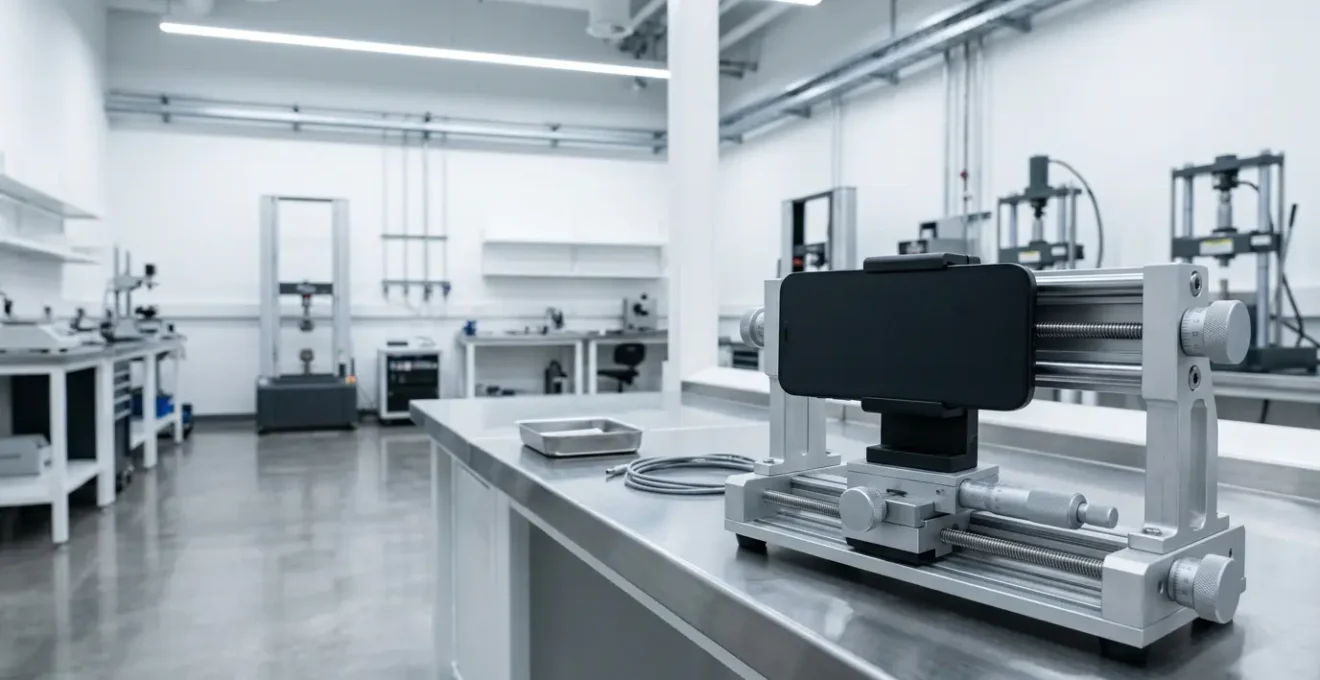
The secret to a tough phone isn’t a brand name or a military sticker; it’s the physical engineering you can test yourself, right in the shop.
- Focus on torsional rigidity—the ‘twist test’—to feel the frame’s real strength.
- Favour polymer (plastic) frames that absorb shock over metal ones that bend and transfer the impact straight to the guts of the phone.
Recommendation: Use the physical checks in this guide before you buy. It’s the only way to know if a phone will actually survive the job site.
Another phone down the drain. You feel that sickening, slow bend as you crouch down, or you pull it out of your pocket to see the dreaded spiderweb crack. For a tradesman, a phone isn’t just a gadget; it’s a critical tool. But most modern smartphones feel like they’re designed for an office desk, not a building site in Birmingham. You’ve probably been told the usual advice: get a bulky ‘unbreakable’ case or spend a fortune on a specialist ‘rugged’ phone that’s slow and clumsy. The truth is, these are just plasters on a wound.
The real problem is the structural integrity of the phone itself. Since the infamous ‘Bendgate’ incident, manufacturers have gotten better, but the pressure to make phones thinner and lighter often comes at the cost of rigidity. According to recent industry analysis, consumers spent a staggering $8.3 billion on screen repairs in a single year, a figure that has nearly tripled since 2018. That’s a lot of money that could be staying in your pocket. But what if the key wasn’t just to protect the phone from the outside, but to choose one that’s built like a proper piece of kit from the inside out? This guide isn’t about fancy specs; it’s a foreman’s advice on how to spot real-world toughness, teaching you to think like an engineer and test a phone’s backbone before you part with your cash.
This article breaks down the essential structural elements to look for. We’ll cover everything from how to perform a simple ‘twist test’ in the store to understanding why some materials handle a drop better than others, and what those military-grade certifications actually mean for your day-to-day work.
Contents: A Tradesman’s Blueprint for a Tougher Phone
- Why do slim phones bend under pressure in tight jeans pockets?
- How to check a phone’s frame strength in-store without damaging it?
- Metal or Polymer frames: which absorbs shock better on a concrete floor?
- The subtle frame warp that destroys waterproofing seals silently
- How to organize your tool belt to protect your mobile device effectively?
- How does reinforced polymer disperse shock energy away from the motherboard?
- Why the vibration test matters more than the drop test for commuters?
- Military-Grade Protection: What Does MIL-STD-810H Actually Mean for Your Daily Phone Use?
Why do slim phones bend under pressure in tight jeans pockets?
It all comes down to a simple engineering principle: leverage. A modern smartphone, especially a slim one, is a long, thin beam. When you put it in a pocket and then sit, crouch, or lean against something, your body applies force to the ends of the phone while your pocket creates a pressure point in the middle. This creates immense leverage forces that the phone’s thin frame was never designed to handle. Think of it like trying to snap a long, thin piece of wood over your knee—it doesn’t take much effort.
The industry had its wake-up call with the infamous ‘Bendgate’ scandal. When a major manufacturer released a new, much thinner model, users quickly found the phones were permanently bending in their pockets. This wasn’t a manufacturing defect; it was a design flaw. The aluminium frame was too thin and lacked the internal reinforcement to resist these common leverage forces. It demonstrated that a phone’s material is only part of the story; the internal structure and overall rigidity are what truly determine if it will survive being carried around on a job site.
The pressure for aesthetics—making a phone as sleek and light as possible—is in direct conflict with the need for durability. Manufacturers have to balance the premium feel of a thin metal body with the structural reinforcement needed to prevent it from folding under real-world stress. For a tradesperson, this means you can’t trust looks alone. A phone that looks and feels solid might have a critical weakness in its design, just waiting for that one awkward movement to reveal itself.
How to check a phone’s frame strength in-store without damaging it?
You don’t need fancy equipment to spot a weak frame. A few simple, non-destructive tests you can do in the shop can tell you more about a phone’s build quality than any marketing slogan. The most important of these is the test for torsional rigidity—or, as I call it, the ‘twist test’. A well-built phone should feel like a single, solid block, or ‘monolithic’, with virtually no give.
To perform the test, hold the phone firmly at both ends, as if you were about to wring out a wet cloth. Apply gentle but firm twisting pressure. You’re not trying to break it, just to feel for any flex, creaking, or movement. A phone with a strong, well-engineered chassis will resist this force with almost no flex. A weaker phone will feel spongy and you might even hear faint creaks from the frame or see the screen discolor slightly under the pressure. This is your first and biggest red flag.
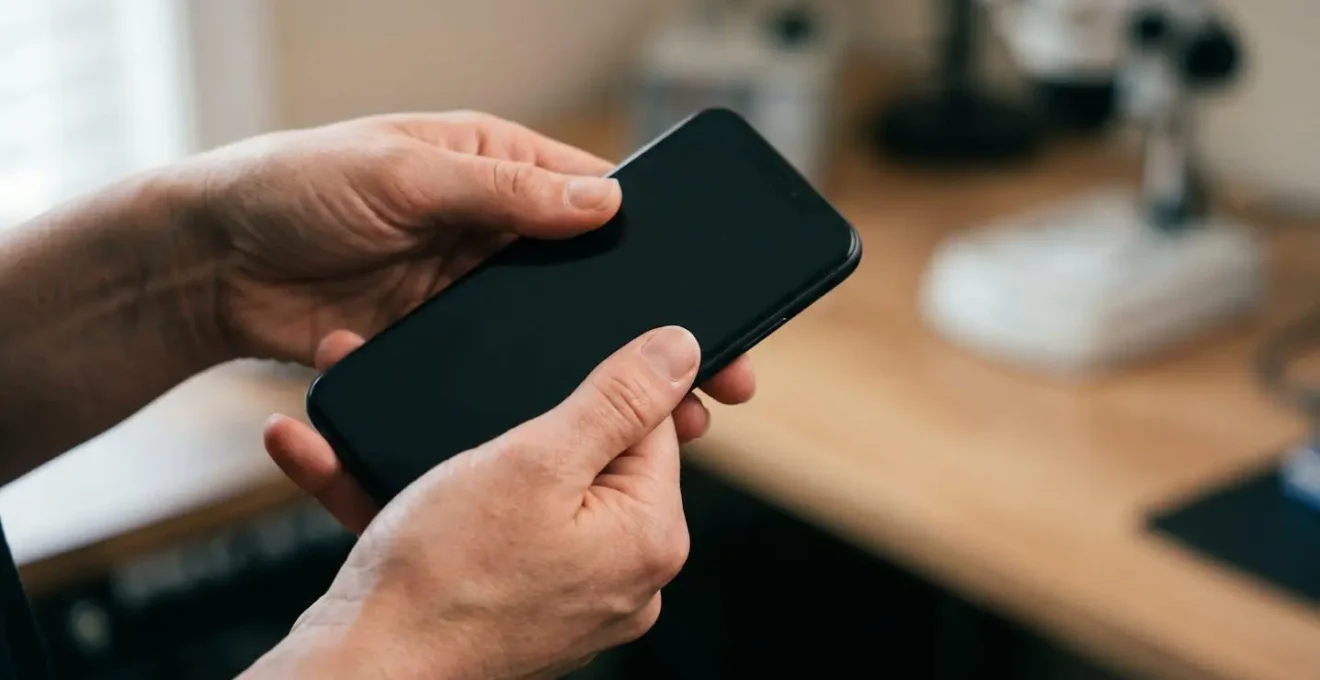
This simple action mimics the twisting forces your phone experiences daily in a pocket or tool belt. A frame that flexes easily is one that will eventually lead to screen cracks, internal damage, and broken waterproof seals. Beyond the twist test, you can use a checklist of other physical inspections to build a complete picture of the phone’s structural integrity before you even turn it on.
Your In-Store Strength Audit: 5 Points to Check
- Identify Weak Points: Visually inspect all points of entry. Look at the seams where the screen meets the frame and check the area around the charging port and buttons. Are the gaps tight and uniform, or are they uneven and large? Poor tolerances are a sign of a weak chassis.
- Gather Physical Feedback: Perform the ‘twist test’ as described above. Additionally, tap firmly around the back and frame with your knuckle. A solid, dense ‘thud’ suggests good internal assembly, while a hollow, resonant sound can indicate flimsy construction and empty space.
- Check for Consistency: Does the phone feel like one solid piece (monolithic)? As you handle it, check if the weight feels balanced. Any creaks or flexing during normal handling indicate a lack of structural coherence.
- Assess Tactile Feedback: Press the power and volume buttons. Do they give a crisp, satisfying click, or do they feel mushy and wobbly? Wobbly buttons suggest the frame is allowing too much flex, which is a major sign of poor rigidity.
- Make the Go/No-Go Decision: Based on the feedback from these tests, decide if the build quality meets your standards. If it feels anything less than rock-solid in your hands, it won’t stand a chance on the job site.
Metal or Polymer frames: which absorbs shock better on a concrete floor?
There’s a common belief that metal is always stronger than plastic, but when it comes to surviving a drop onto a concrete floor, it’s not that simple. The key difference lies in how each material handles impact energy. You need to understand the difference between plastic deformation and elastic deformation. Metal, like aluminium, often undergoes plastic deformation. When dropped, it dents. That dent is permanent, and the energy that caused it is transferred directly through the frame to the fragile components inside, like the screen and motherboard.
High-quality polymers (plastics), on the other hand, are designed for elastic deformation. When a polymer frame hits the ground, it flexes, absorbs the shock energy, and then returns to its original shape. It acts like a built-in shock absorber. This is why a materials engineering comparison revealed that a polycarbonate-framed phone dropped from the same height as an aluminium one often fares much better. The aluminium phone gets a permanent dent and transfers the force inward, while the polymer phone’s frame flexes to dissipate the energy, protecting the internals. Independent lab tests confirm this, showing that multi-layer TPU cases reduced peak impact force by up to 78%, whereas aluminium cases only managed a 22% reduction.
So, while an aluminium frame might feel more ‘premium’ in your hand, it’s often more brittle. For a job site environment, a well-engineered, thick polymer or composite frame is almost always the superior choice for drop protection. It’s not about feeling premium; it’s about surviving the inevitable. The goal is for the frame to sacrifice itself by absorbing and dispersing energy, rather than staying rigid and letting the shock wave travel straight to the phone’s delicate electronics.
The subtle frame warp that destroys waterproofing seals silently
One of the most common and costly failures on a modern phone is water damage, and it often happens on devices that are supposedly ‘water-resistant’. The problem isn’t always a dramatic drop into a puddle; it’s often a ‘silent killer’ caused by a subtle, almost invisible warp in the phone’s frame. That IP68 rating you see advertised relies on tiny, flexible elastomeric gaskets and adhesives sealing every gap and port. These seals are only effective as long as the two surfaces they sit between remain perfectly flush.
Even a minor bend or twist in the phone’s frame from being in a tight pocket or from a small drop can create a microscopic gap in that seal. You won’t see it, and the phone might work perfectly fine, but the water resistance is now gone. The next time you’re caught in the rain or a bit of dust gets in, it has a direct path to the motherboard. This is why many manufacturers, despite advertising high IP ratings, explicitly state that water damage is not covered under warranty. They know these seals are fragile and can be compromised by the normal wear and tear of daily use, especially in a demanding environment.
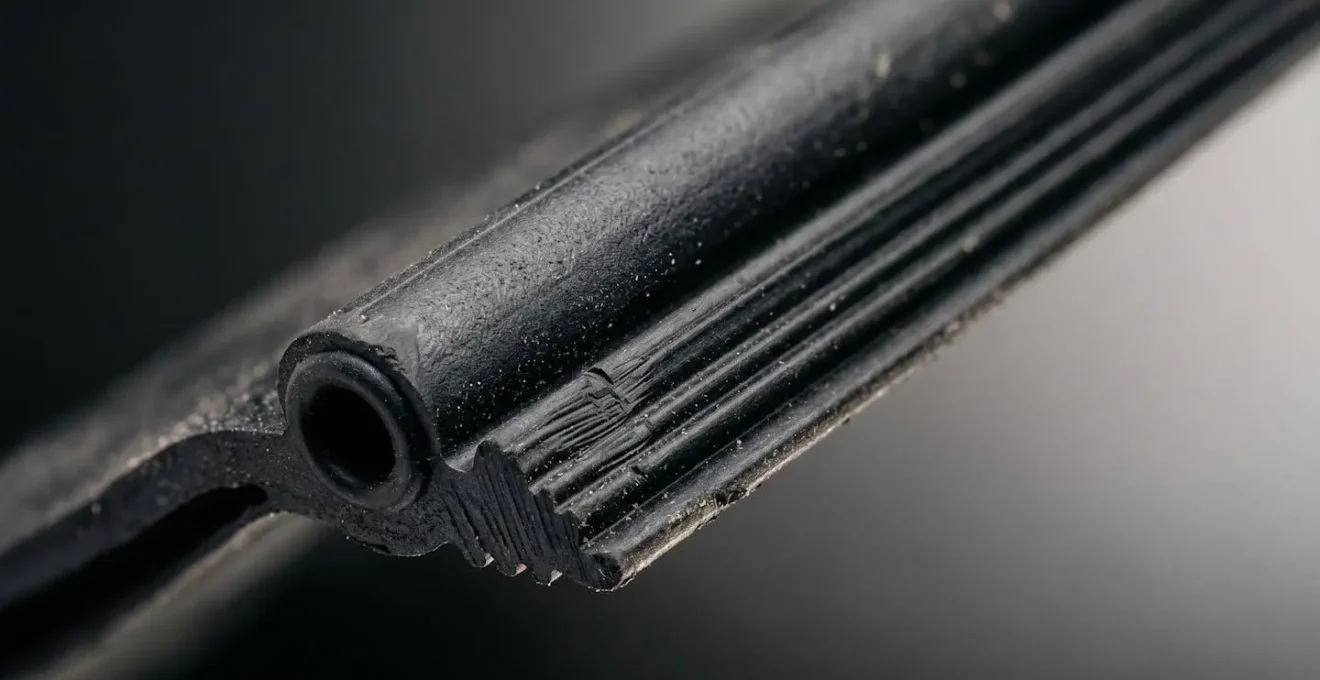
This goes back to the importance of torsional rigidity. A phone with a strong, stiff frame is far less likely to develop these subtle warps. It maintains the precise alignment needed for the waterproofing seals to do their job. When you’re testing a phone in the store, you’re not just checking if it will bend in half; you’re testing if it has the structural integrity to protect its own most vulnerable defence system against the elements. A flimsy frame is a guarantee of future water damage, no matter what the IP rating says on the box.
How to organize your tool belt to protect your mobile device effectively?
Even the toughest phone needs a bit of common sense protection on a job site. Your tool belt is a minefield of potential damage, from sharp pressure points to impact hazards. Tossing your phone into a pouch with a handful of screws or letting it rattle against a wrench is a recipe for disaster. The key is to treat your phone like the precision instrument it is and give it a dedicated, safe space. Here are four rules to live by when setting up your tool belt.
- The Isolation Principle: Your phone must have its own dedicated, padded pouch. Never let it share space with hard tools like pliers, screwdrivers, or wrenches. These create concentrated pressure points that can crack a screen or bend a frame, and act as tiny hammers during any impact.
- Strategic Positioning: Where you wear the pouch is critical. Avoid the back pockets at all costs, as this creates the highest risk of leverage-based bending when you sit or crouch. The safest position is on the front of your hip. This prevents it from being crushed when you sit in a vehicle or lean against a wall.
- Magnetic Contamination Prevention: Be mindful of magnets. Some tool pouches use strong magnetic clasps, and many modern tools like stud finders or parts trays use powerful neodymium magnets. These can permanently interfere with your phone’s internal compass, optical image stabilization (OIS) in the camera, and NFC sensors used for wireless payments. Keep your phone physically separate from these.
- Dust and Debris Protection: A job site is full of abrasive dust, metal filings, and dirt. This grime can act like sandpaper on your screen and, more importantly, can clog and damage your charging port. Always use a pouch with a protective top flap or zipper to keep this debris out. This kind of damage is not related to drops or bends but can be just as fatal to your device.
Your phone’s survival on site doesn’t just depend on its build quality; it also depends on your daily habits. A well-organized tool belt is your first and best line of defence against the most common types of damage a tradesperson faces.
How does reinforced polymer disperse shock energy away from the motherboard?
When a phone with a well-designed polymer frame hits the ground, a sophisticated process of energy management kicks in. It’s not just a simple plastic box; it’s an engineered system designed to divert impact forces away from the most critical components. Advanced rugged designs use a multi-layer architecture, where different materials are given specific jobs. Typically, this involves a hard polycarbonate exoskeleton for overall rigidity, which is then overmolded with a softer, more rubbery material like TPU.
This dual-layer system is crucial. The hard outer shell spreads the initial impact force over a much wider surface area, preventing a single point from taking the full brunt of the hit. The softer layer underneath then does the heavy lifting of shock absorption, compressing and deforming to soak up the energy. But the real cleverness is on the inside. Engineers mould internal ribs, honeycomb patterns, and standoffs directly into the chassis. These structures act like the trusses on a bridge, creating dedicated pathways that channel the shockwave’s energy around the delicate motherboard and into the main, solid parts of the frame. This prevents the concentrated stress that can crack solder joints or dislodge components.
There is, however, a trade-off to consider with polymer frames: heat. Unlike aluminium, which is an excellent thermal conductor, polymer is an insulator. This means it’s not as effective at dissipating heat generated by the phone’s processor. Thermal modelling has shown that under heavy load, such as continuous video recording, internal temperatures can be 7-10°C higher in polymer-cased phones compared to aluminium ones. For most trade work this is not an issue, but it’s a small price to pay for superior impact protection.
Why the vibration test matters more than the drop test for commuters?
Everyone worries about dropping their phone, but for anyone who spends their day in a work van or around machinery, there’s a far more insidious threat: vibration. Constant, low-level oscillations from a vehicle’s engine or the hum of power tools can be more damaging over time than a single, catastrophic drop. This is another one of those silent killers. These micro-vibrations can slowly work internal components loose, cause solder joints on the motherboard to fracture, and even shake camera modules or other tiny sensors until they fail.
This is why, within the military testing standards, the vibration test is just as important as the drop test. A phone might be able to survive a fall, but if it can’t handle the daily rattle of being in a van driving over rough roads, it’s not truly ‘rugged’. For example, as part of its MIL-STD-810H certification, a device like the Samsung Galaxy XCover7 Pro withstood three hours of continuous vibration testing across all three axes to prove it could handle these real-world conditions. This is a far better indicator of long-term durability for a tradesperson than a simple drop test onto a flat surface.
Drop tests are often performed in perfect laboratory conditions. As the Vertu Engineering Team notes, these standardized procedures often fail to replicate the chaos of a real-world accident. In their guide, they point out:
These tests don’t account for the everyday accidents that are more likely to damage your phone: scratches from keys, the constant stress of being in your pocket, or a short fall onto a hard, uneven surface.
– Vertu Engineering Team, How to Test Your Phone’s Durability: A Guide Beyond Military Grade
For a tradesperson, the accumulated stress from vibration is a constant. It’s a test of the quality of the phone’s internal assembly and the resilience of every single connection. When looking at a phone’s durability claims, don’t just focus on the drop height; find out if it has been properly tested to withstand the vibrations of your daily work life.
Key Takeaways
- Torsional rigidity, assessed with a simple ‘twist test’ in-store, is the single best indicator of a phone’s real-world frame strength.
- Well-engineered polymer frames absorb and disperse shock far better than metal frames, which tend to dent and transfer damaging impact energy to internal components.
- A ‘Military-Grade’ sticker is a testing methodology, not a certification; you must look at the specific tests passed (like vibration and fluid contamination) to see if they’re relevant to a job site.
Military-Grade Protection: What Does MIL-STD-810H Actually Mean for Your Daily Phone Use?
You see the “Military-Grade Protection” or “MIL-STD-810H Certified” sticker on everything from phone cases to the phones themselves. It sounds impressive, but it’s one of the most misunderstood terms in tech. The first thing to know is that it’s not a ‘certification’ at all. As the technical team at Android Authority clarifies, there is no independent body that awards a seal of approval. The standard is a testing methodology, and the manufacturer performs the tests themselves.
MIL-STD-810H is a ‘testing methodology’, not a ‘certification’. The manufacturer performs the tests themselves and there is no independent body that awards a ‘MIL-STD’ seal of approval.
– Android Authority Technical Team, What does MIL-STD-810 mean? Combat ready phones explained
This means a manufacturer can test for just one or two of the many available procedures and still claim their product is “built to MIL-STD-810H standards”. The full U.S. Department of Defense testing methodology involves 29 different tests, covering everything from shock and vibration to extreme temperatures, humidity, and even fungal resistance. For a phone to be truly useful for a tradesperson, it needs to have passed the tests that are actually relevant to a construction site environment, not just the ones that are easy to pass and look good on a spec sheet.
So, when a manufacturer makes this claim, your job is to dig deeper and ask: which specific tests were passed? For a tradesperson, some tests are far more important than others. The table below breaks down the most critical tests and why they matter for someone on the tools.
| Test Method | What It Tests | Relevance for Trade Use | Example Parameters |
|---|---|---|---|
| 516.8 Shock/Drop | Impact resistance from falls | Critical – phones dropped from tool belts, vehicles | 26 drops from 1.5m onto steel |
| 514.8 Vibration | Resistance to prolonged oscillation | High – work trucks, power tools, machinery | 3 hours across all axes |
| 510.7 Sand and Dust | Particle ingress protection | Critical – construction sites, outdoor work | Exposure to fine sand particles |
| 509.7 Salt Fog | Corrosion resistance | Medium – coastal work, marine environments | Salt spray exposure testing |
| 504.3 Fluid Contamination | Resistance to solvents, fuels, cleaners | High – automotive, industrial chemicals | Exposure to petrochemical solvents |
| 502.7/503.7 Temperature | Extreme hot and cold operation | High – outdoor work in all seasons | -40°C to +70°C cycling |
Don’t be fooled by the marketing. A MIL-STD-810H claim is only as good as the specific tests that back it up. Always check the fine print to see if the phone has been tested against the challenges of a real job site, as detailed in this breakdown of IP and MIL-STD ratings.
So, the next time you’re in a phone shop, ignore the flashy displays and marketing promises. Take the device in your hands, perform the twist test, check the buttons, and tap the frame. Think like an engineer, not a consumer. Making an informed decision based on physical build quality is the surest way to get a tool that will last, saving you time, money, and a whole lot of frustration. Your wallet will thank you for it.